


Do We Do As in Rome?

In this article, Zoe discusses the structural and culture shifts that need to occur to bring us back to an Ideal Version of the Internet.
When travelling, they say “do as the Romans do in Rome.” On a recent trip, I suggested to my friends that we adopt a…. unique interpretation of that piece of advice. After picking a dating app popular in that country, I created a profile made up of pictures and answers to the prompts contributed by each of us. Over the course of a week, we received multiple invitations to chat, and we picked six of them to have brief conversations with. Interestingly, after giving them real details about us (our likes, experiences in the country and some personal details about us), they were very quick to ask us to go out for dinner or a hang out. This was too quick for my Singaporean self who was used to the much slower, small talk build up stage so I declined, saying that I was just on the platform “while visiting”. Of the six, four said they didn’t mind and continued to text us until we left the platform. I was surprised because it would have been more understandable leaving us on read — why engage when it won’t go any further?
We seem to tolerate a lot on these dating apps. Most of the youth I chatted with shared that that’s pretty much the culture; it’s possible you get a good match, but first you must be prepared to go through the ghosting, low-effort or small talk conversations, or even having people hit you up in ways that give you second-hand embarrassment. A recent article by Straits Times made the dismalness of the culture even obvious when they published the article ““It’s not just you: What 1,000 people said about their dating struggles”. 67.5% of the article’s respondents (aged between 18-35 years old) reported dating app fatigue — “a cycle of chatting, conversations fading, deleting the app and then eventually returning.” The fundamental purpose of these dating platforms is to encourage connection and to broaden the circles you move in to increase the chances of you finding a partner you like; in fact, Hinge’s brand tagline is that it was “made to be deleted.” However, it seems that dating apps are leaving us lonelier than we expected.
That might be a manifestation of the main problem; we have begun to accept too much bad etiquette (no high ground from me here) on the Internet in exchange for the hope of having a good outcome. For this article, I narrowed it down to dating apps because it represents an area of online culture that faces the same issues that most social media platforms do, but is not getting the same amount of attention or determination to make the space better. The reality is that we aren’t leaving these platforms, or even if we leave one app, it’s just for another version that promises to be better. If we’re not going anywhere, I hope to at least convince you to consider if this is a version of the Internet that we are satisfied with.
It Is That Bleak Out There, Unfortunately
To find out what the youth think, I spoke to Singaporean youths who had been on dating apps — some university undergraduates, NSFs and poly/JC students. While I recognise that their experiences may not be entirely representative of the Singaporean youth population’s experiences, I found that some of their responses made it easier to understand Gen Z perspectives on dating apps and how we engage with it.
Note: All names have been changed to maintain anonymity.
Do you feel you have been successful on the dating app(s) you used?

Based on the responses, success on dating apps is defined by the ability to make good connections with others, and having that connection lead to a romantic relationship (on a semi-permanent or permanent basis). While a lot of the respondents said that they wanted to pursue something serious, it also seemed to be that their attitudes towards the connections they made on the app were nonchalant — if it worked out or was interesting, great! Otherwise, no harm no foul.
When you were deciding which platform to use, what were certain features/perceptions that drew you to the apps?

Cheryl also shared that when she started using Hinge during polytechnic, she knew that most of her friends were also using it — “everyone goes through that phase especially in school [when] you see your friends using it”. Overall, social pressures and word-of-mouth reviews about the apps being able to find you the type of partner you wanted were the main considerations when choosing factors.
Was it hard to connect with people on the app?

I asked some of the respondents about whether they had been ghosted before as well — they said that it was common to have very late replies. Most of the time, they shared that the delay in the replies would just be taken as a passive way of telling the other person you were not interested. They did think it was rude and that being behind a screen was probably why the people felt that it was okay to ghost or blue-tick. Ghosting has been studied fairly widely as a phenomenon of disrespect, but it didn’t seem that the youth I spoke to were that offended by it. It seemed that the passive rejection was better than an outright rejection.
Have you ever felt unsafe on the dating app(s)? What experiences have you had that you are willing to share?

TIL (time I learnt) from Albert that the verification features on the dating apps are mostly concerned with verifying if you are a human being, so it’s still easy for people to impersonate others.
It's also increasingly easy to pretend to be someone else, even if you are a real person using an account (which I can unfortunately confirm). The Hinge 2025 Gen Z report highlights that 52% of Gen Z daters (aged between 18-22 years old) are open to using AI to “vibe check” their messages or bios before sending them to ensure that they are giving off the right impression. The introduction of the AI conversation starter by Hinge seems to tell us that users are worried about being “cringe” too and want the seemingly perfect response to help them get things started. One of the other phenomena is the sharing of bad Hinge profiles, particularly from male users (it’s tough out here huh….)
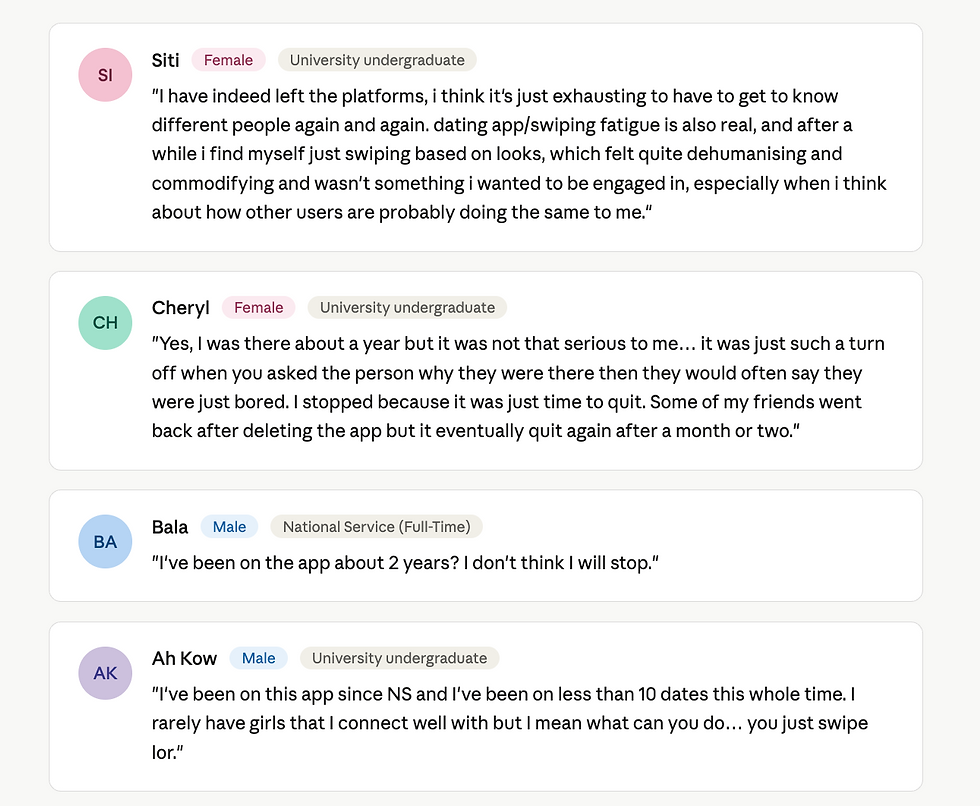
Did you ever leave the dating app(s)? What motivated you to?
As a final point, I also asked some people if they were using Telegram dating bots. The feedback was that the bots are less engaging to pick someone to talk to because there are no pictures included, just question prompts. It also felt more suspicious because you were interacting with a person who you knew almost nothing about (unless their responses were really good or if they saved your contact, which would show you their profile pictures and bios at least). The base of users also felt smaller to some, so they ultimately didn’t use it for very long. It demonstrated that youth are cognisant of the dangers and are able to exercise autonomy to protect themselves or to take risks that they feel they can manage.
Ok, so is Gen Z doomed?
As cultures shift, so do the attitudes and expectations of its users. What others feel is unacceptable doesn’t mean it’s bad — up until the 1980s, they used to smoke on planes! What matters is whether the generation is equipped with knowledge to understand both sides of the debate, and then exercise their discretion to decide if the practice is healthy and acceptable to them. We can’t smoke on airplanes today anymore because the priority has shifted to focus less on individual comfort, and instead a more socially acceptable consideration of collective wellbeing.
Similarly, one of the new features is the use of AI to help you when you’re not sure what to say next, which is meant to prompt deeper conversations. This would be something that could be regarded as taking shortcuts or the death of conversational ability. For users who are more introverted or nervous to start conversations, having these prompts lowers the barrier to entry for them to start participating in the dating pool. That is arguably an inclusive development, which means the platforms are proactive about addressing the previously hidden needs of their users. Of course, the contrasting school of thought is that it robs the person of eventually achieving authentic presentation since they’d be likely to opt for the safer and more socially acceptable response each time. That is a decision each user must make for themselves, based on what they know about themselves.
What I can confidently conclude as a whole is that these are the characteristics which define Gen Z daters: we are SAFE.
Self-aware - we know our emotional limits which means we can’t have high effort conversations with everyone, and we can recognise the risks that we take across the different dating platforms
Armoured with nonchalance - most seem to have this “come what may” attitude but there is an unspoken yearning to make a connection, which pushes us forward to continue using the various platforms even when it is mid or to innovate new ways to connect with others to form romantic relationships
Forgiving - what would have been previously viewed as poor conduct is now viewed from a different perspective that justifies it by identifying a hidden need for users (e.g AI prompts or ghosting)
Exhausted - so many people suffer from ‘dating app fatigue’, or emotional burn out from trying to connect with others and failing
Don’t worry guys… you are not alone in this fight to recover our right to decide
The other thing that stood out to me is that Cheryl shared that in place of the apps, more of her friends would ‘shoot their shot via IG DMs’ after an introduction by a friend or at least having met the person. I thought this was interesting that youth were using other platforms that were not designed for the sole purpose of making a romantic connection — it signalled that we have chosen to bypass the failures of the apps with innovative ways to connect to people. That shouldn’t be the status quo though. The internet culture is shaped by not only its users but the platforms (i.e the infrastructure of online society). In fact, there is a symbiotic relationship between what the users expect and what the platforms teach them to expect – like if X is the standard, and you have only known a reality with X, it’s hard to imagine anything better or it becoming possible. By accepting X, you tell the platform: “It's all good! Keep going queen!"
There are things that platforms can control and SHOULD: more effective systems to manage user reports of harassment. Some of the interviewees shared that they had reported users for offensive or intrusive comments made in conversation, or for offensive profiles (e.g racial slurs, sexually offensive come ons) but had seen the same profiles reappear. There is also the growing concern of the “addictive” design within the apps; in 2024, there was a lawsuit brought by six plaintiffs from New York, California and Florida. They argued that dating app parent company Match Group gamifies the services "to transform users into gamblers locked in a search for psychological rewards that Match makes elusive on purpose." There is an increasing shift in the international community to place pressure on platforms to be accountable for what happens on their platforms, and creation of enforcement mechanisms that focus on more efficiently removing harmful content from the platforms (see our compilation of headlines on what governments around the world are doing!) This is signalling to us that if you came for a service and it’s being delivered badly or hurting you, we don’t have to just take it.
As the secondary actor that can influence culture, it continues to be our responsibility to examine how our behaviour has been unknowingly shaped by the existing infrastructure. It is my honest belief that as a generation, Gen Z and our early millennials are introspective enough — we can tell when we have endorsed bad practices. What these changes in the culture are meant to do is to help us see what we have been unknowingly accepting as normal, and then to use that new perspective and knowledge to decide if we are satisfied with this quality of culture. This is the age of autonomy - don’t just let the tide pull you away. Make the decision to continue surfing in the same way or to course correct if you need it.


well said zoe! treat everyone as you treat yourself