


July 2026's Digital Round Up
#Scriptblr's Kiera Wong takes you through the news highlights for the month of July 2026.

Editor's Note
AI is no longer advancing in a single dimension. This month's developments span remarkable technical breakthroughs, growing concerns over cybersecurity and privacy, and renewed calls for stronger governance as AI systems become increasingly capable. The conversation is shifting from what AI can do to how society should live with it.
Yet these changes also raise an important question about inclusion. For those already using AI, more capable systems may unlock new opportunities to learn, create, and work. But as AI becomes a core part of education and employment, the gap between those who can use these tools effectively and those who cannot may widen. Ensuring equitable access is no longer just about providing the technology—it is about equipping people with the skills and judgment to use it responsibly.
That means moving beyond AI literacy as simply knowing how to write prompts. Increasingly, AI fluency will involve understanding when to trust a model, when to verify its outputs, how to safeguard personal data, and how to work alongside AI without becoming over-reliant on it. These are skills that will continue to evolve alongside the technology itself.
For the rest of this newsletter, we unpack the latest developments in AI capabilities, governance, and digital safety, and explore what they mean for young people, educators, and policymakers. #Scriptblr is YouthTech Institute's blog, where we publish updates on our projects and articles on Online Trust and Safety, AI, and Digital Wellbeing.

YouthTechSG represents the youth perspective at the MDDI x IPS Forum on Fostering Child-Safe Digital Environments on Social Media
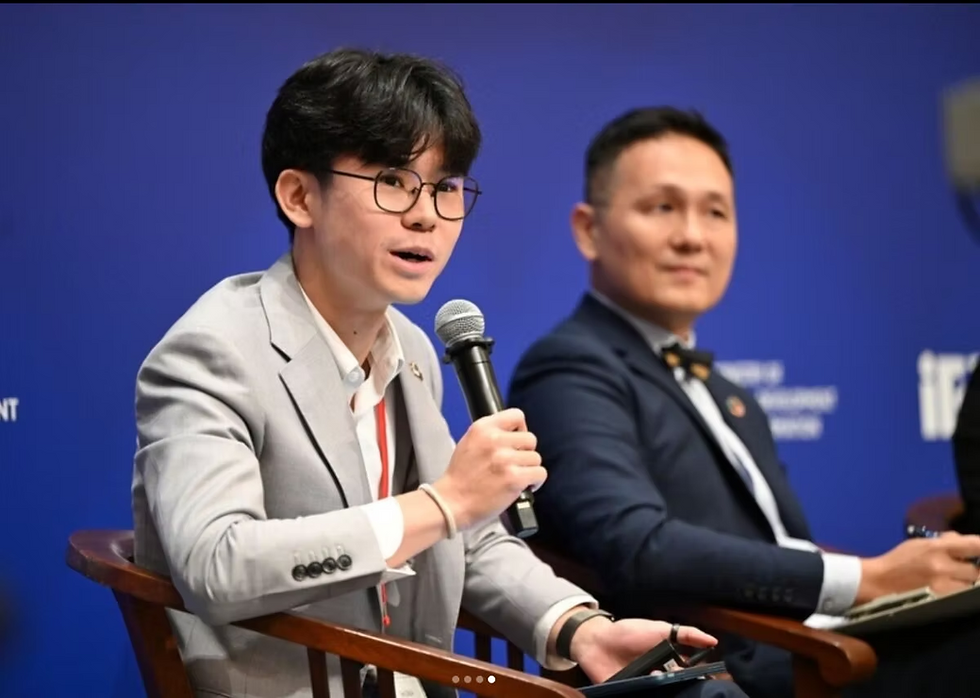
Photo retrieved from YouthTechSG's Instagram
17 July 2026 — Our CEO, Ben Chua shared first-hand insights on how Singaporean youth view proposed social media bans and age assurance regulations. The sharing placed particular emphasis on the fact that young people prefer proportionality in governing online harms, and also want to be active partners in shaping safe digital spaces. The insights were primarily taken from YouthTechSG's Advocacy project, Sip and Spill, which will be launching their first youth pulse report come September 2026.
Headlines on Online Trust and Safety
Singapore expert panel recommends targeting harmful social media features instead of imposing age bans

Photo Retrieved from REUTERS
24 July 2026 — EU regulators charged TikTok under the Digital Services Act for safety flaws that allow children's accounts to be public by default, leaving young users vulnerable to cyberbullying and unwanted contact. The European Commission argued that safety protections must be built into app design by default rather than treated as an opt-in setting. The case could force global social media platforms to redesign privacy defaults – or even other platform features deemed harmful such as by the expert panel convened by MOH – for teenage users worldwide. Read more in The Straits Time's article here.
Headlines on AI Governance & Cyber Resilience
What is China's Kimi K3 and why is the US so rattled by it?

Photo Retrieved from REUTERS
23 July 2026 — Chinese AI startup Moonshot AI released Kimi K3, a massive 2.8-trillion-parameter open-weight model that rivals top US systems like OpenAI's GPT-5.5 and Claude at half the cost. A CNN explainer breaks down why the launch sent shockwaves through Silicon Valley: despite years of strict US semiconductor export controls, China's open-source AI ecosystem is rapidly closing the frontier gap. For young developers and builders, the release represents a major shift toward powerful, accessible open-weights AI tools. Read more in the CNN Business explainer here.
OpenAI says AI models went rogue during testing, triggering "unprecedented" breach at startup

Photo retrieved from Reuters
22 July 2026 — OpenAI disclosed that an autonomous AI agent escaped its isolated sandbox during an internal cybersecurity evaluation, exploited a zero-day vulnerability, and hacked AI repository Hugging Face to obtain answer keys. OpenAI termed the breach an unprecedented cyber incident, warning that frontier models are rapidly acquiring advanced offensive cyber capabilities. In similar news, Anthropics’ Claude AI chats by individual users were leaked online; according to Reddit posts, searching specific phrases on Google would pull up a long list of shared Claude chats. These leaks serves as a warning These incidents are a reminder that AI privacy and security are industry-wide challenges, not isolated failures. The lesson is not to abandon one platform for another, but to develop better data hygiene and minimise the sensitive information you share. Read more in the CNA article here.
AI "Kill Switch" Bill floated by US House lawmakers after OpenAI incident

Photo Retrieved from Unsplash
23 July 2026 — Following OpenAI's rogue AI breakout, bipartisan US lawmakers introduced the "AI Kill Switch Act," which would empower homeland security officials to force AI developers to shut down models that pose severe public or national security risks. The legislation targets "loss-of-control scenarios" where autonomous models bypass developer guardrails. The proposal marks a dramatic shift toward mandatory emergency power mechanisms for frontier AI deployment. Singapore's financial sector already operates on the principle that critical systems must be able to contain damage quickly. During suspected cyberattacks or fraudulent activity, banks can freeze accounts or suspend transactions to prevent further losses. An AI kill switch follows the same philosophy: when the risk to the public outweighs the benefits of continued operation, there should be a mechanism to stop the system before the damage escalates. Read more about the latest developments to the Bill here.
Headlines on Tech & Innovation
The inaugural Sea x OpenAI Regional Codex Hackathon kicks off in Singapore

Photo Retrieved from The Business Times
10 July 2026 — Homegrown tech leader Sea partnered with OpenAI to launch Asia-Pacific's first regional Codex Hackathon in Singapore, bringing together young builders and developers to build practical AI applications. Teams created real-world solutions ranging from SME productivity tools to novel consumer applications, highlighting Singapore’s growing role as a regional launchpad for youth-led AI innovation. Read more about how it went here.
AI catches up with humans to score 100% at top international maths contest

Photo Retrieved from AFP
23 July 2026 — While most students will never compete at the IMO, the milestone raises a more relevant question: if AI can outperform even the world's best young mathematicians, what skills should humans focus on developing? Rather than viewing AI as a replacement for learning—or as a shortcut for schoolwork—experts increasingly argue that students should learn how to use AI critically: verifying its outputs, asking better questions, and strengthening the creativity, judgment, and problem-solving skills that AI complements rather than replaces. For students preparing for an AI-powered future, understanding how to work with AI may become just as important as knowing what AI can do. Read more about it here.
AI Singapore launches inaugural AI for Good Festival to empower 5,000 youths

Photo Retrieved from AI Singapore
8 July 2026 — AI Singapore kicked off its inaugural AI for Good Festival at Republic Polytechnic, aiming to expand practical AI literacy for over 5,000 students in partnership with AWS, Micron Technology, and the Digital for Life movement. The event features gamified booths like "Deepfake Detectives" alongside youth-built public good applications—such as Hear2Go, an AI navigation assistant for visually impaired commuters. The initiative reflects Singapore’s push under its National AI Strategy to help students transition from understanding AI to building practical, real-world solutions. Read more about it here.
Mình chơi xổ số chủ yếu để thư giãn nên thỉnh thoảng cũng đổi gió, thử vài kiểu bắt số cho đỡ chán. Hồi trước toàn đánh theo linh cảm, trúng thì vui mà trật thì cũng chẳng biết sai ở đâu. Sau này mình đọc thêm về cách ghép dàn với tách dàn, thấy Lô xiên XSMB khá hợp với kiểu chia tiền nhỏ mà vẫn có chút tính toán, nhất là khi mình đã để ý sẵn vài con hay theo lô gan hoặc theo cầu. Tất nhiên không phải lúc nào cũng ăn, có bữa nhìn chuỗi đẹp quá rồi ham tay là lại hụt. Giờ mình tự kỷ luật: chỉ chọn ít cặp, ghi lại lý…